Thursday, September 07, 2006

Sepias and Allegorical Miniatures
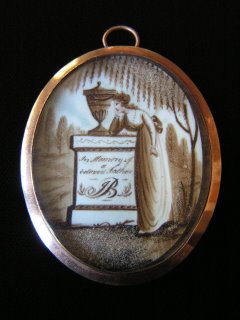
Miniatures painted in sepia are another perplexing form of sentimental jewelry. There is a great deal of disagreement over what exactly a sepia is. I define sepias as miniatures painted in watercolor on ivory in either a shade of gray, brown, or black. The sepia paint may or may not be entirely derived from or include “dissolved” human hair, that is, hair that has been ground into a fine dust with mortar and pestle so as to be fit for a paint base. Like cameos, portraits of individual sitters or more frequently allegories may be painted in sepia. Because sepias depicting mourning allegories are by far the most common, it is generally assumed that all sepias were mourning jewelry. However, this is not the case. Sepias depicting shepherdesses, Greek gods, republican symbolism (personifications of liberty, liberty staff and cap, cornucopias, and other revolutionary insignia), domestic scenes, landscapes, friendship allegories, and risqué copies of French art are also common enough.

The Apotheosis of Daniel Legate, Jr.

Mourning sepia on ivory with mourner dressed in classical garb, a weeping willow, urn, chopped hair ground, and inscription on the plinth, “DANL. LEGATE JUN. OB: 10TH April 1791.” The cameo-like portrait medallions surrounding the memorial were a popular addition to cemetery monuments in the 1790s. The spirit of Daniel Legate reclines wrapped in clouds above the mourner and next to the inscription on the upper left edge, “WEEP NOT FOR ME.” The reverse composed of a hairwork ground covered with tiny gold stars. The hair of the deceased literally forms the heavenly ether, a symbolic union of body and spirit.

Mourning Sepia on ivory, circa 1780, with chopped hair, weeping willow, female mourner dressed in classical clothing, urn, and inscription on the plinth, "In Memory of a Beloved Father, JB.” The reverse is inscribed with the initials, “C.M.B.”


John Barry (fl. 1784-1827) Portrait sepia on ivory of father and daughter, c. 1785, with hairwork.


Charles Hayter (1761-1835) Maternal Allegory
I use the term "allegorical miniature" to denote full color miniatures that otherwise resemble sepias in their visual and thematic composition. This watercolor on ivory miniature, circa 1795, represents a mother with her son, dressed like Gainsborough's "Blue Boy," and daughter, dressed like Lawrence's "Pinky," resting on a bench in an Arcadian landscape.

Hayter served as Teacher of Perspective to Princess Charlotte. The above miniature displays Hayter's short, compact, oblique brush strokes, blue shading to the recesses of the face especially the corners of the eyes, and the blue, green, yellow color scheme borrowed from “Newton’s rainbow” and intended to resonate with “the cold part of the iris” (Hayter 1815). The Maternal Allegory likewise illustrates several of Hayter’s (1815) fourteen enumerated rules to be observed in shading:
Rule 1
The greatest distance in an open scene, with a clear sky, will always be the palest…
3 The nearest objects, or those in the foreground of an open scene, will have the darkest shades…
5 To adapt the picture to the power and properties of the eye, you must, on all occasions, lay as tender, gradual, and imperceptible a shade as possible, at each corner of a square or oblong drawing, blending it sweetly off towards the point of sight, so as to give the surface a concave apperance. The same should be done towards the margin of a circular drawing; always securing this natural concave effect.
6 Always begin with pale tint of the sky and distant masses of shade; and as you approach the foreground, increase the depth of the tint, observing to be light enough at first.
7 When you require additional strength of shade, do not take a darker tint for that purpose, but repeat the use of the original tint; strengthening the shades of all the degrees of distance with its own tint, or the object will press too forward.

Tuesday, September 05, 2006

Hairwork Jewelry: Palette Worked Hair

“Drawing from his bosom a locket, which was attached to a slight steel chain, he opened it and showed me a tress of golden hair. “In this curl is clasped the history of my life, friend,’ he said, with calm sorrow. “’Tis only a woman’s hair,’ as poor Swift wrote once; yet it is this which has made me what I am. God rules us all. He makes us very weak, that, in our weakness, He may make His own strength perfect. To one comes joy and laughter; to another tears. I accept my part, and bow to Him who is Lord of all” – Anonymous, 1859

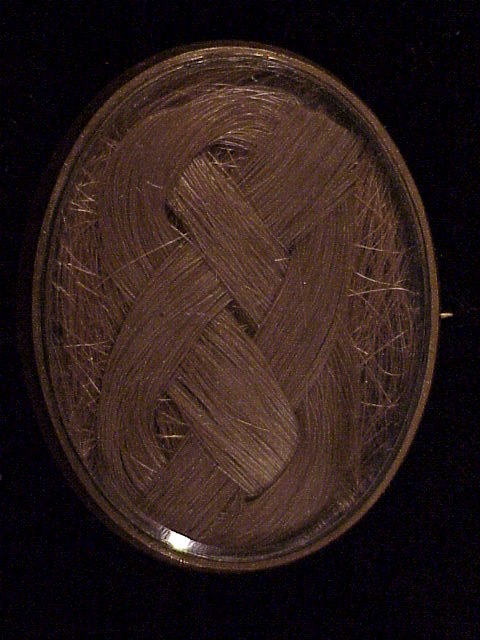
Jewelry incorporating human hair have been in existence since at least the 1500s. They probably share a cultural lineage with Christian relics, which housed various body parts of saints or martyrs and were believed to possess spiritual power. Early hairwork jewelry from the sixteenth and seventeenth centuries were frequently love tokens or mourning jewelry incorporating the hair of a loved one rather than a saint, and they often included momento mori symbolism. Hairwork jewelry became popular in Europe and America after 1760 and extremely popular after the industrial revolution provided the middle classes with less expensive, mass produced jewelry findings. It is a common mistake to assume that all hairwork jewelry were mourning objects. In this latter period, hairwork jewelry provided a sentimental memorial to love, friendship, family, celebrity, and, of course, mourning.

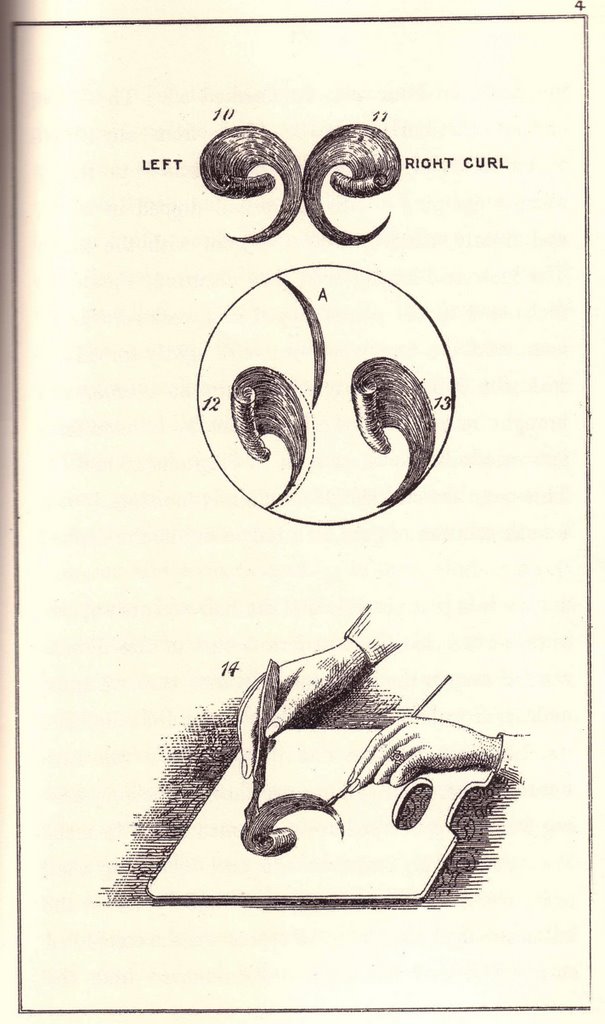
Hairwork jewelry designed and executed on an artist’s palette is referred to as “palette worked.” The designs produced by palette work range from simple basket weaves to extremely intricate and symbolic or allegorical scenes.

Illustration plate demonstrating a step in the art of palette working hair from Alexanna Speight's (1872) The Lock of Hair.

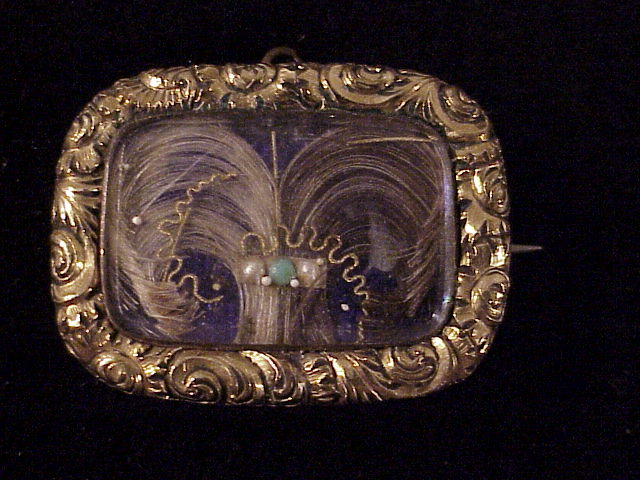
Georgian brooch containing two palette worked curls mounted on blue enamel backed by embossed foil.

This pendent brooch contains a palette worked forget-me-not and curl on translucent milk glass backed by embossed red foil.

On the reverse, there are two hairwork curls each labeled with initials, “E.O.” and “H.C.O.,” spelled out in tiny seed pearls on translucent blue enamel plaques backed with embossed foil.

This brooch contains a beautiful palette worked feather sculpted from red hair with flower, branch, and the initials “B.P.” on opalescent glass.

Hairwork Jewelry: Table Worked Hair

The revival of hairwork jewelry in the 1980-90s has revealed that the equipment and basic patterns for table work hair braiding are identical to kumihimo braiding in Japan. Kumihimo braiding was used to construct durable silk cords for clothing and samurai armor from at least 700 AD to the present. However, this method of working hair was probably independently invented in Europe and shares no lineage with Japanese kumihimo. It nevertheless uses the same technique of weighted hair strands joined by a counter weight and passed back and forth across different quadrants of the tabletop.

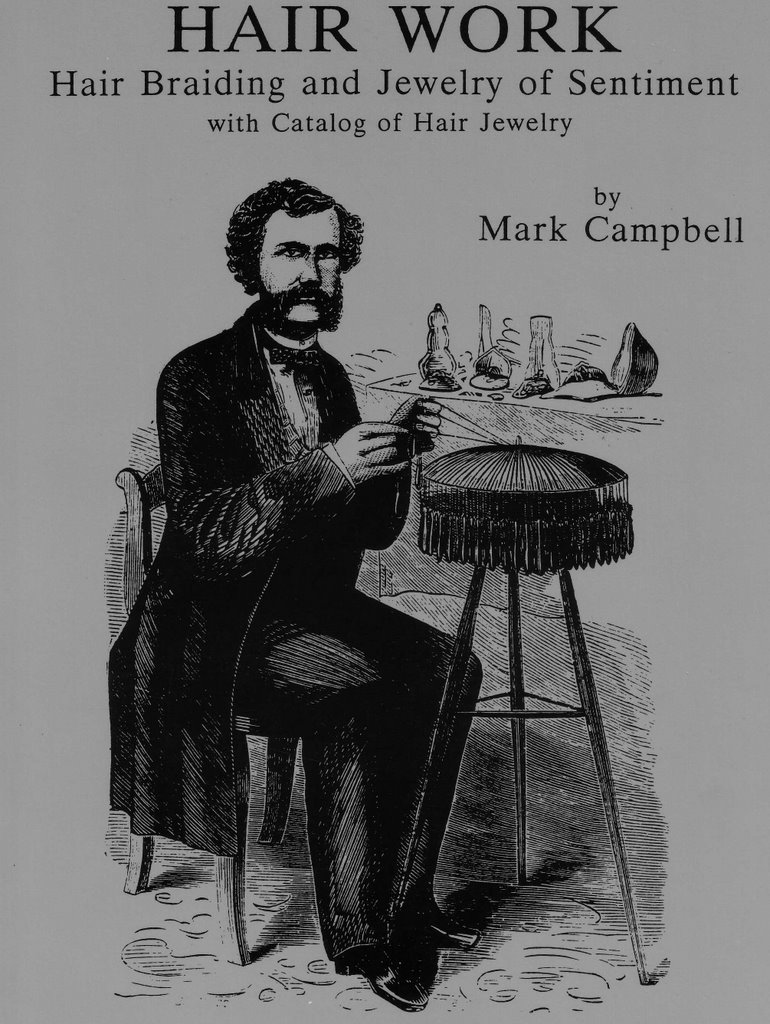
Frontispiece from Mark Campbell's (1875) The Art of Hairwork: Hair Braiding and Jewelry of Sentiment illustrating the table stand used to create hairwork braids.

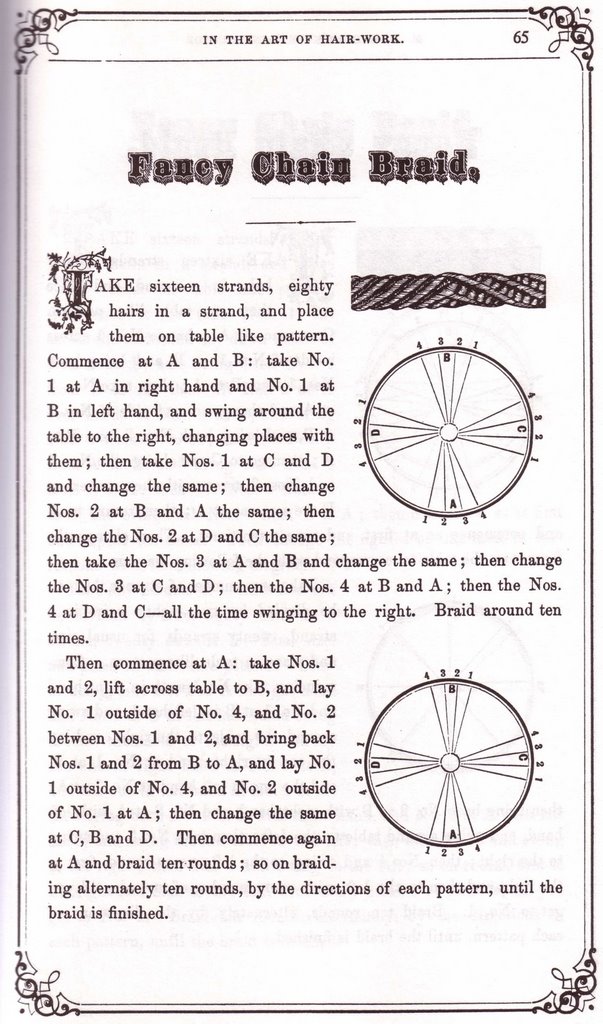
A table work pattern from The Art of Hairwork

Lacis has republished Mark Campbell's books and Alexanna Speight's (1872) The Lock of Hair, which are available through their website. Lacis also has a store in Berkley filled with an amazing selection of books and supplies for the whole spectrum of art and craft textiles and adornment. The staff is freindly, helpful, and willing to share their passion and enthusiasm for all things related to antiques and dress. Check out their website: Lacis

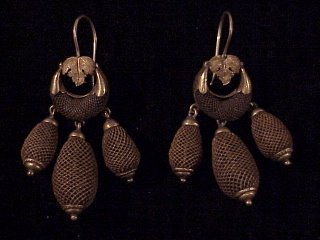
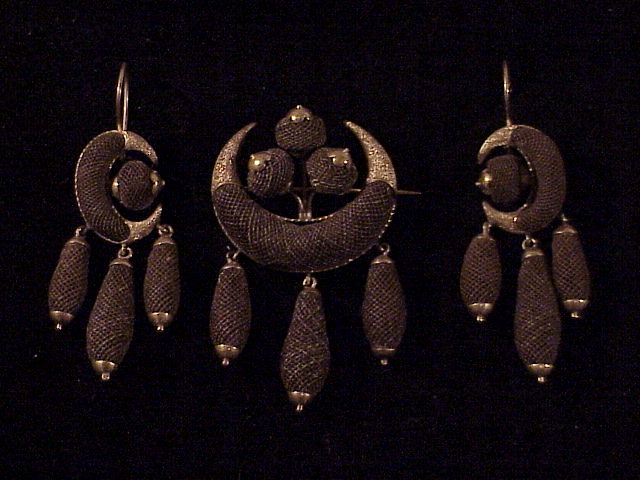
This brooch and earrings set was constructed with the table work method using a pattern for a hollow open work braid.

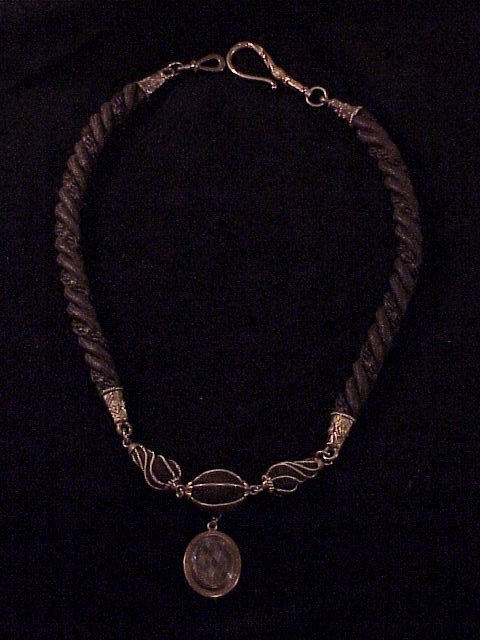
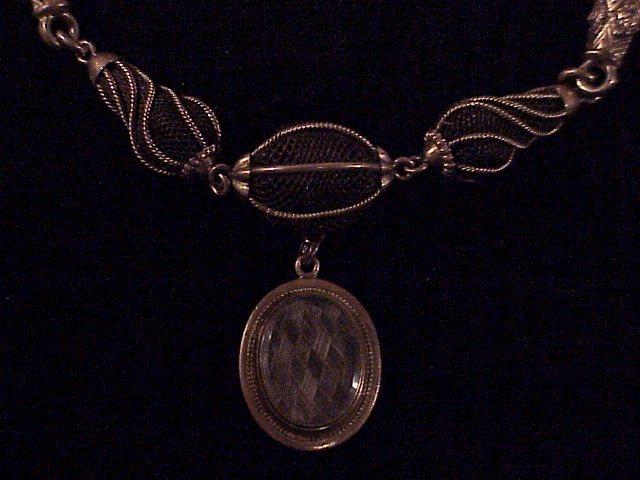
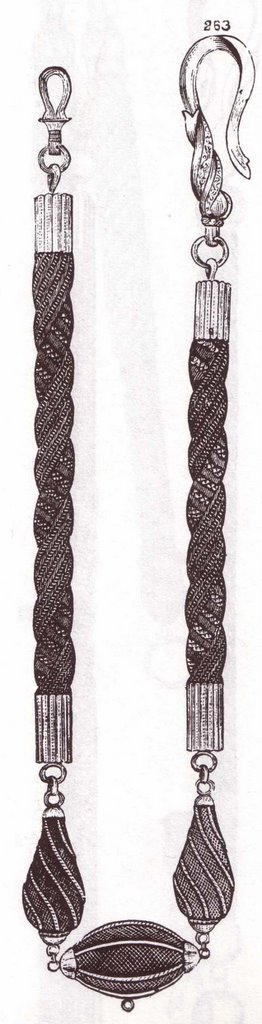
This watch chain was constructed from two different patterns for solid chains, which were then braided together. The hairwork beads encased in gold wire were crafted using a hollow open work pattern.

The hairwork beads suspend a double-sided locket with two different palette worked hair designs on each side.

This engraving of the same watch chain pictured above comes from the catalog pages of Mark Campbell’s 1875 how-to book for the amateur hairworker.

Hairwork Boxes

Hairwork was not limited to jewelry. In the nineteenth century, human hair was added to just about every object suited to receive it, and small boxes were no exception. This ivory box houses a palette worked basket weave design on the lid.

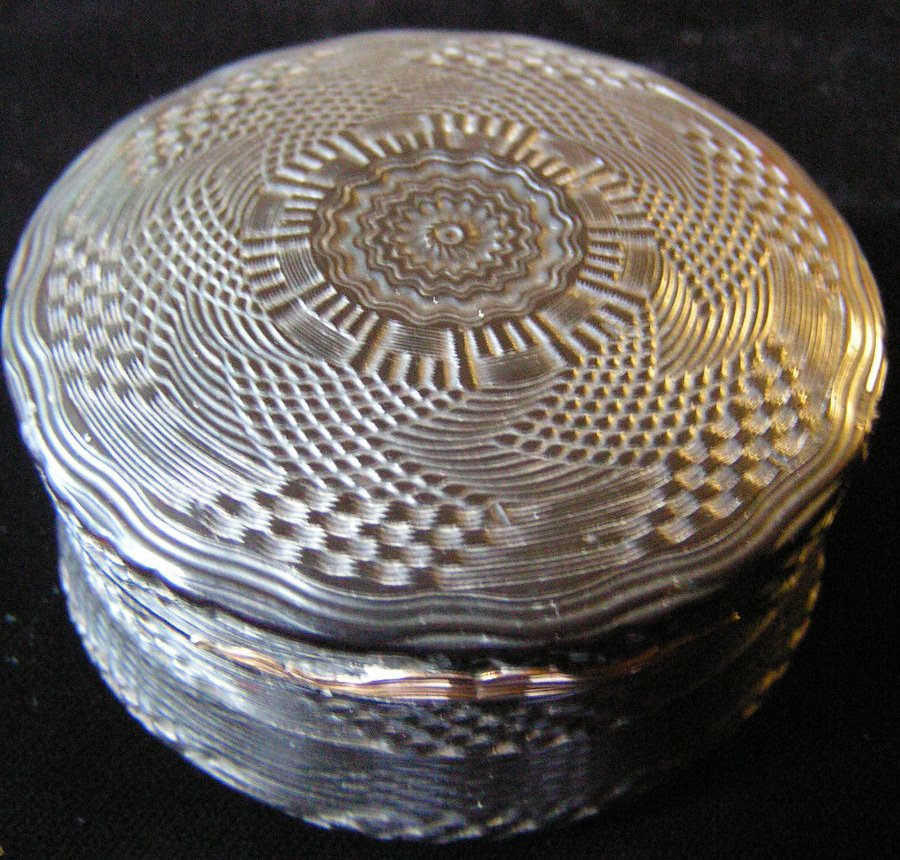
This tortoise shell box has exquisite engine-turned engraving over every part of the outer surface…

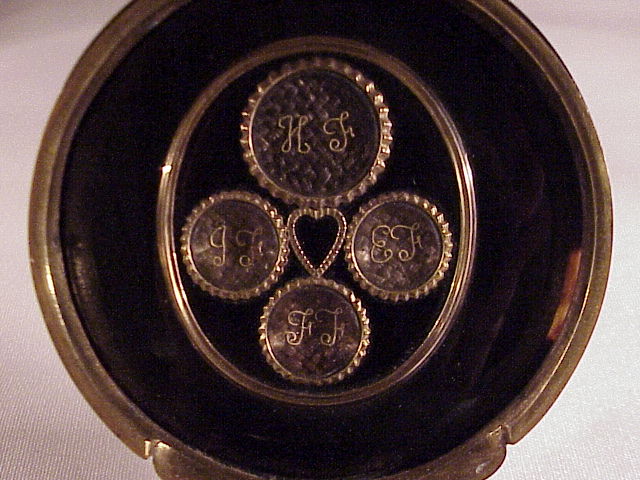
And houses hairwork on the underside of the lid with a gold heart and the initials, “H.F.,” “J.F.,” “E.F.,” and “F.F.,” indicating that the hair probably came from members of a single family.


Ivory box with hairwork on the lid and gold initials, “C.P.M.” The box is slightly curved to fit comfortably in a pocket.

Hairwork Plaques

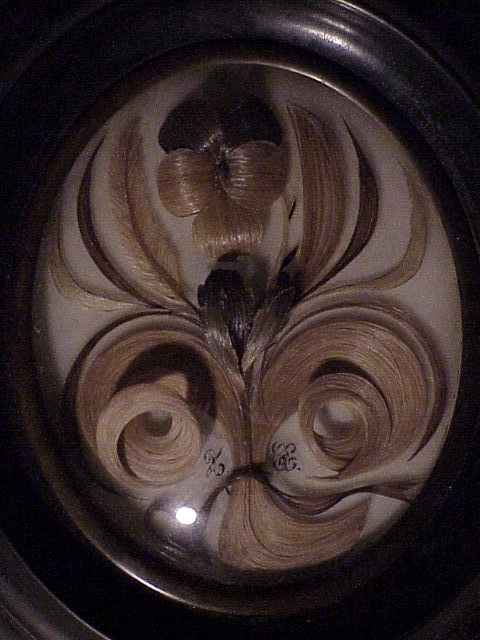
Larger, upwards of fifteen centimeters, hairwork plaques were also produced in the nineteenth century as cabinet pieces. The plaque below houses three different colors of hair arranged into a spray of curls, feathers, and a pansy symbolic of “think-of-me” in the language of flowers.

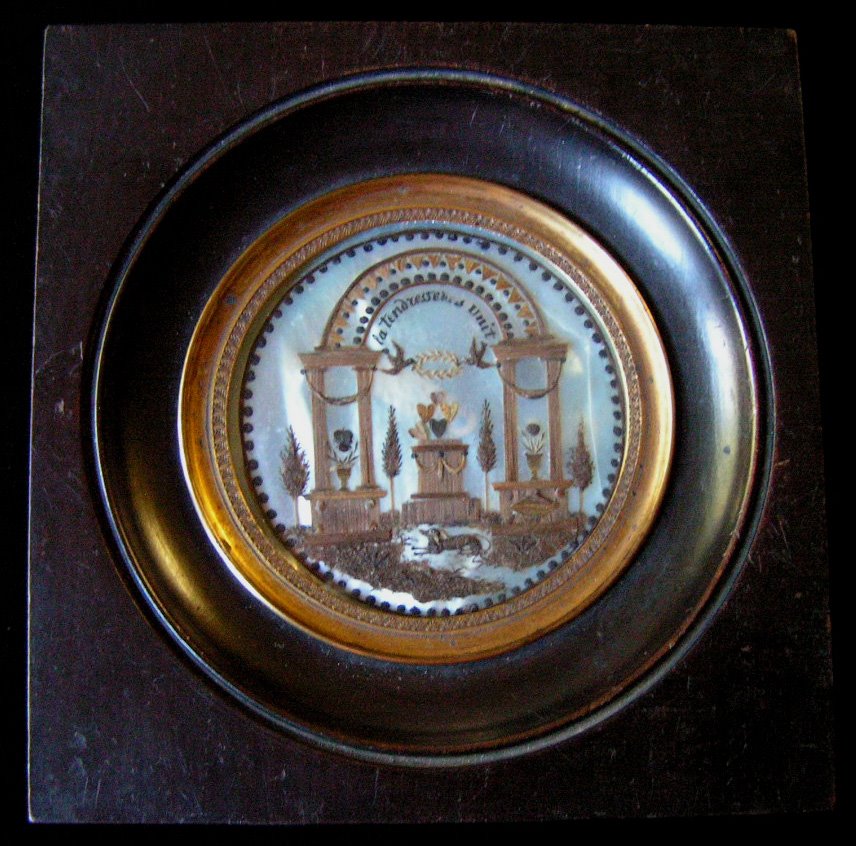
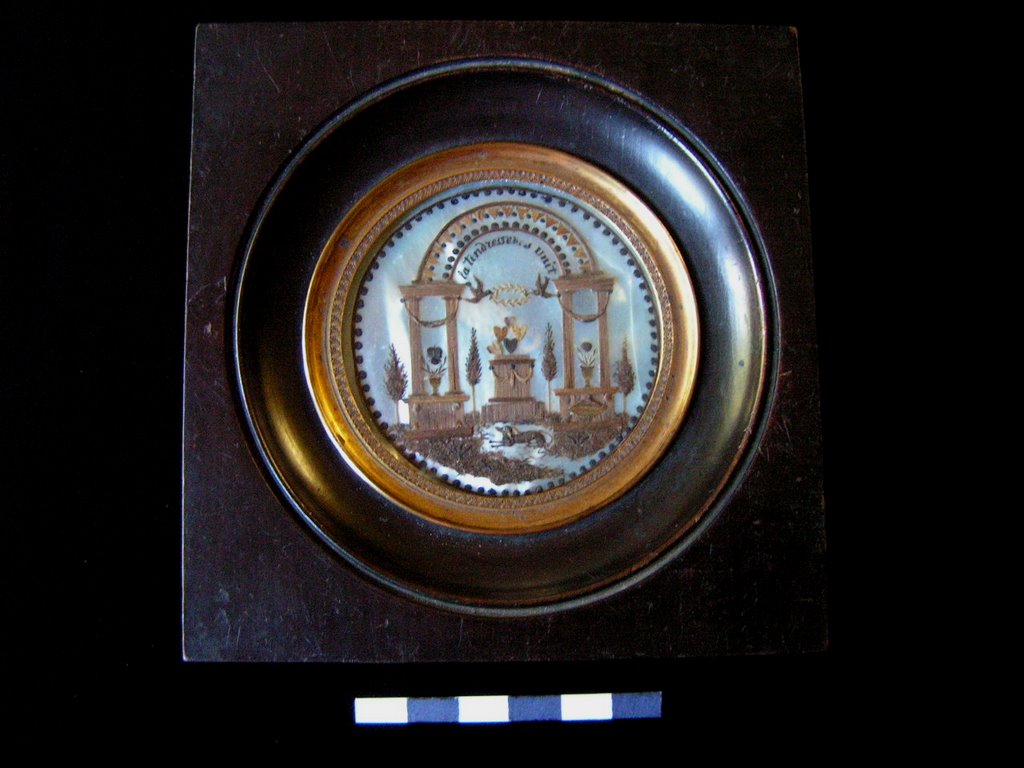
This is one of my favorite pieces of sentimental jewelry from my personal collection. The temple of love constructed entirely from human hair contains the inscription “la tendresse nous unit” or “tenderness units us.” The dog symbolizes fidelity. Atop the altar, the five hearts metonymically represent five actual individuals, who are crowned by two birds symbolizing love and intimacy. The evergreens symbolize constancy, and the pansy, a common symbol in sentimental art, means “think of me.” These symbols unite to form an allegory emphasizing the pledge of a family and/or friends to remain tenderly devoted to each other – a pledge both embodied and reified by a class-marking artifact.

Tuesday, August 15, 2006

Back from Vacation

My wife, Frances, and I are back from our vacation in the California wine country. Frances is a Ph.D. candidate in cultural anthropology, and she is getting ready to move to Jordan for a year to do her dissertation fieldwork. I will not be able to go with her, because I have my big exams to become ABD (all but dissertation) in the fall, so I’m tethered to the university. We’ve been to Jordan many times and I look forward to visiting her over the winter break. It’s beautiful there – hands down the kindest, safest, most hospitable place we’ve ever been to. To convince you that you should go, here are some pictures.

This is the treasury in Petra. The entire façade is carved from rose sandstone, and though this is the most famous building in the ancient Nabatian city, there are hundreds of such structures notched into the winding canyon walls.

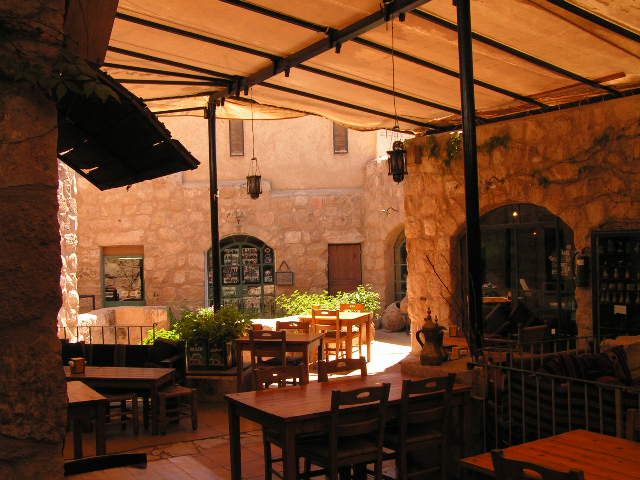
This is our favorite restaurant, Harat Jdoudna, in Madaba, a small town outside of Amman famous for its archaeological parks, ancient mosaics, and mosaic school. The food in Jordan is absolutely wonderful, however Jordanian wine is far less than spectacular.

For great wine, you should try visiting the California wine country. We left with no plans, but to travel north; maybe to Portland, we thought. The whole trip was chance: no reservations in advance, no idea where we would end up. We serendipitously discovered great little bed and breakfasts, wineries, good food, and saw whales playing in the ocean along the way. Sonoma was so pretty that we decided to stay there…


And we bought a lot of wine.

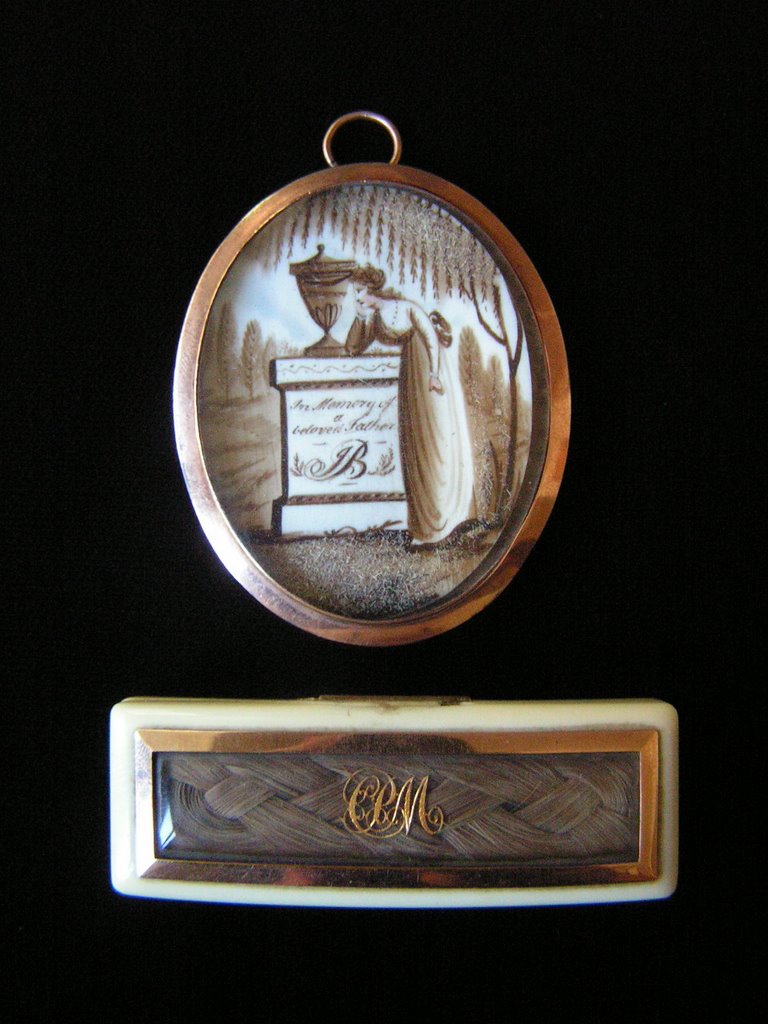
Of course, we also stopped in the bay area to shop for sentimental jewelry. At one little shop, we found an eye miniature surrounded by garnets. The miniature was priced reasonably, in the mid two thousand, but upon inspection under a loop, I could see that the piece was actually a marriage of two separate pieces of antique jewelry. The eye miniature was real, but it had formerly been a ring and the shank was now missing, and the garnet border was actually a separate brooch, which had been superglued onto the miniature! I wish people wouldn’t abuse such rare works of art. At any rate, here are two new additions to my collection.

Mourning sepia on ivory with chopped hair forming the ground and part of the weeping willow. The plinth reads, “In Memory of a Beloved Father, JB” and the reverse is inscribed with the initials, “C.M.B.”

Ivory box with hairwork on the lid and gold initials, “C.P.M.” The box is slightly curved to fit comfortably in a pocket.

Tuesday, August 08, 2006

Out of Town Notice

Please note: I will be out of town until August 16th and unable to answer email until I return.

Meanwhile, enjoy this marble obelisk housing a tinted sepia on ivory representing a shepherdess crowning a lamb and surrounded by an intricate pattern reverse painted on glass. This obelisk will be included in a forthcoming publication on sepias. The obelisk, as well as marble urns housing sepias, are on display at the Edward Dean Museum of Decorative Art.

Tuesday, August 01, 2006

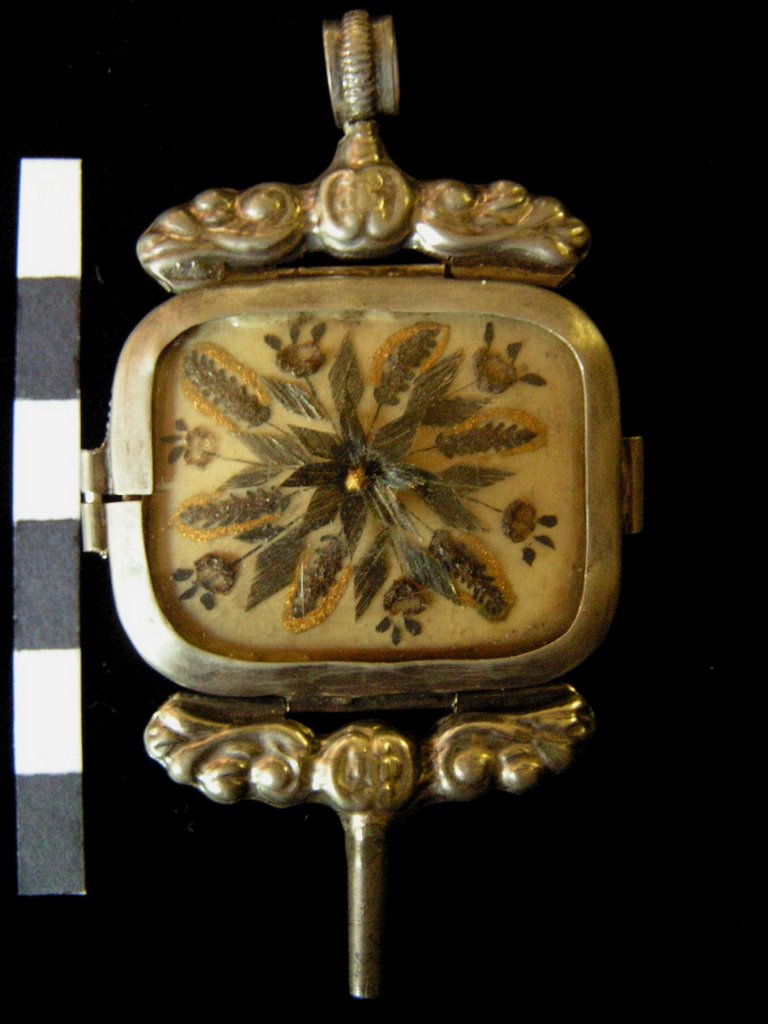
Hairwork Watchkey

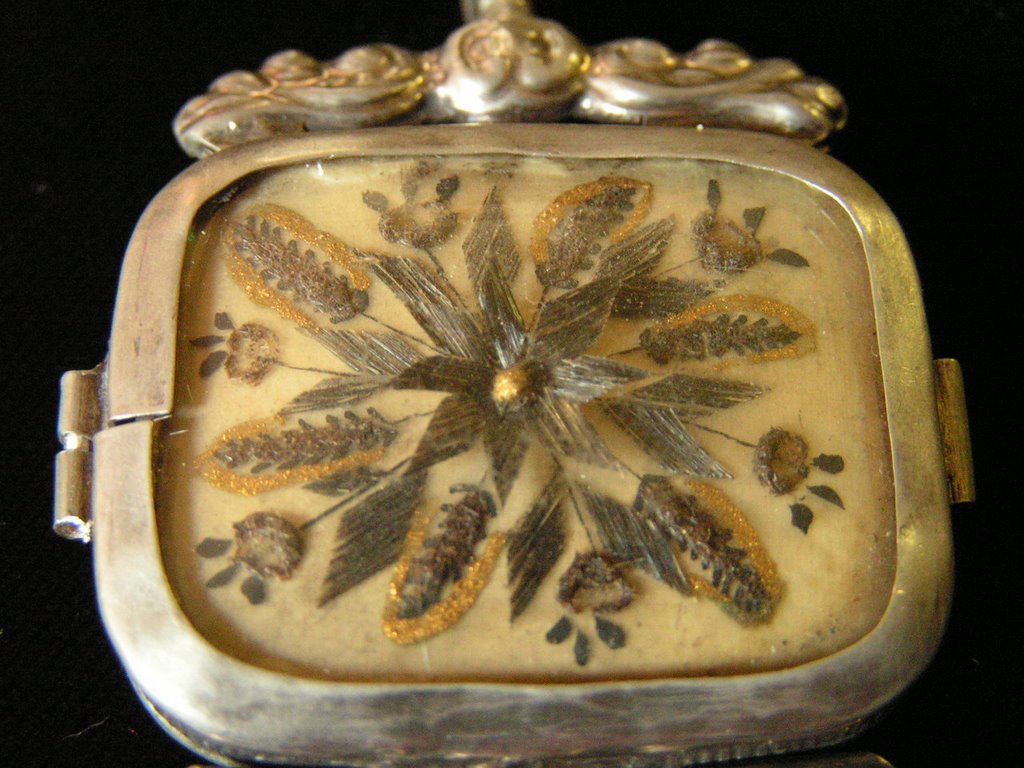
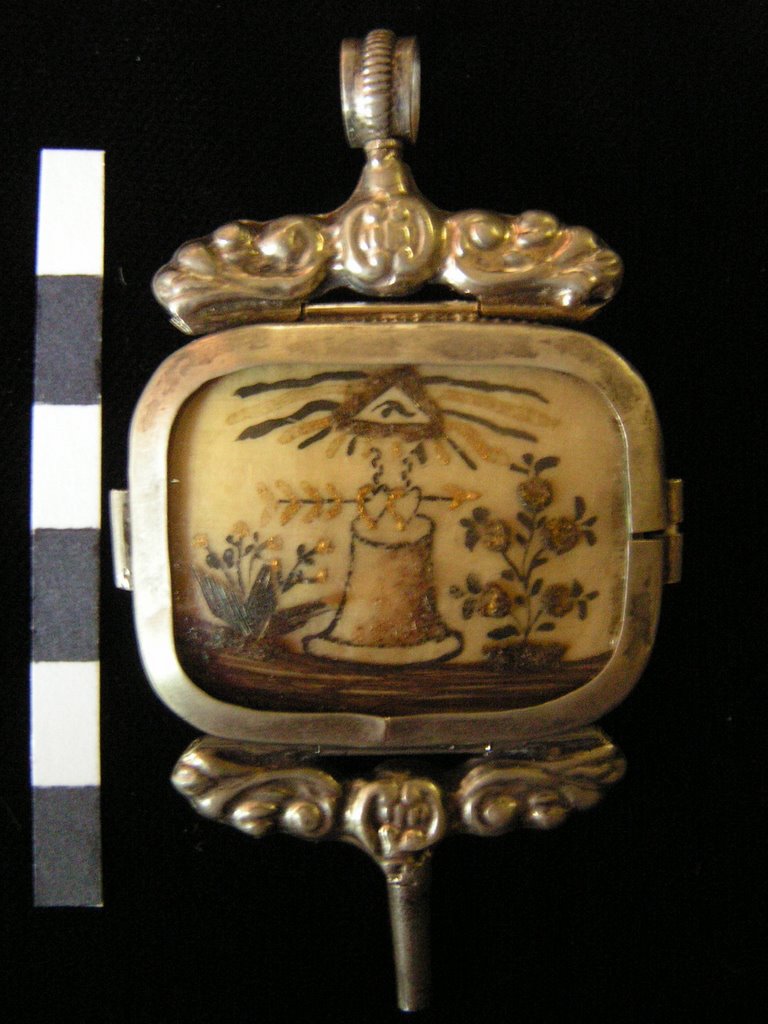
Large Georgian Watchkey with double sided hairwork compartments. The watch key is hinged above and below the hairwork compartments.

Scale in centimeters.

A hairwork flower surrounded by wheat stalks and gold accents on ivory adorn one side.
The other side features a love allegory on ivory with hair, two hearts pierced by a Cupid's arrow, flowers, the eye of God, and gold accents.


In great condition, Price: $450

Thursday, July 20, 2006

Art Nouveau Stickpins

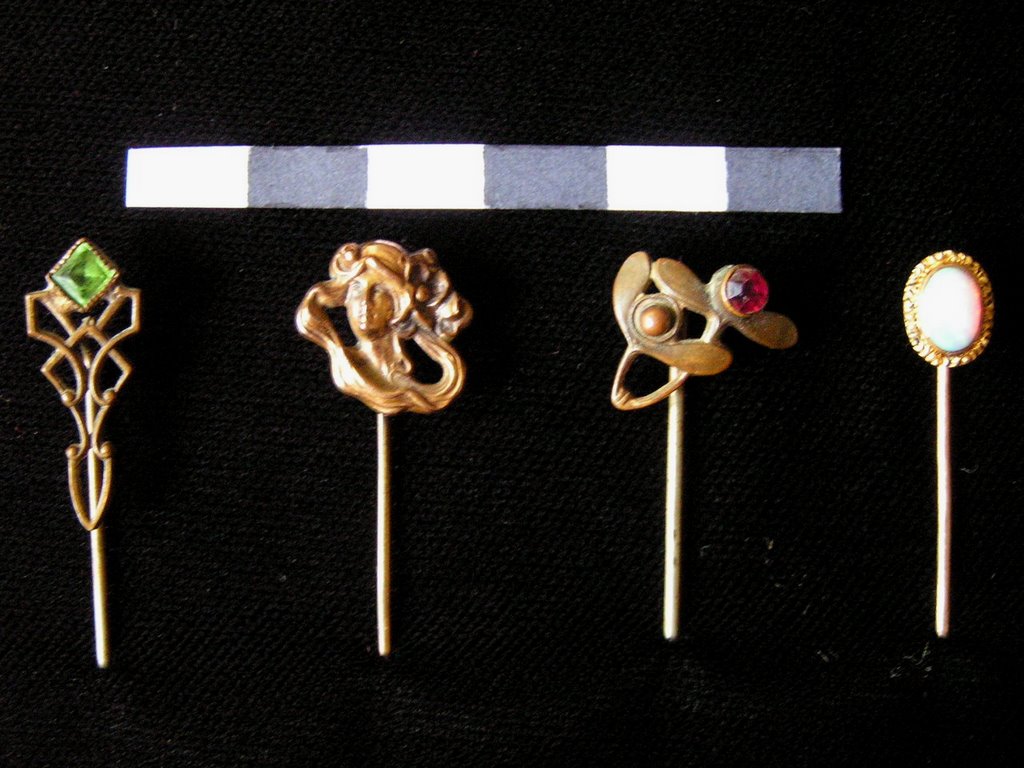
Collection of Art Nouveau, Art Deco, and Edwardian stickpins, look for these added to the “For Sale” post, scale in centimeters.

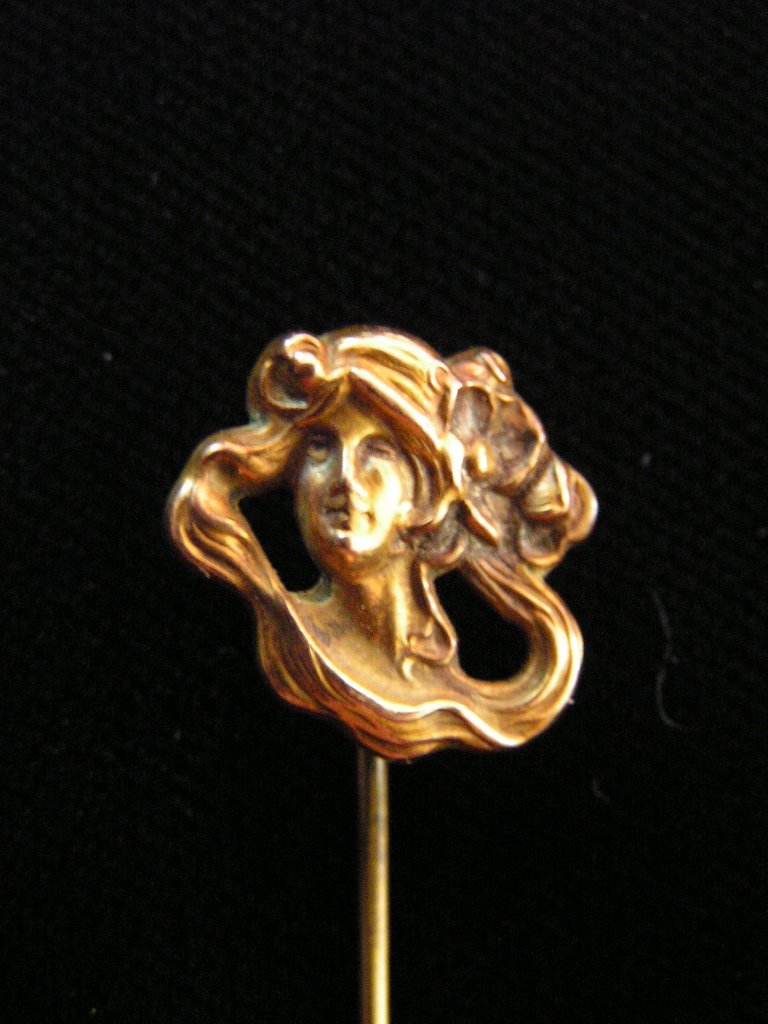
Gilt metal stickpin with Art Nouveau woman with flowing hair. Excellent condition. Price: $75

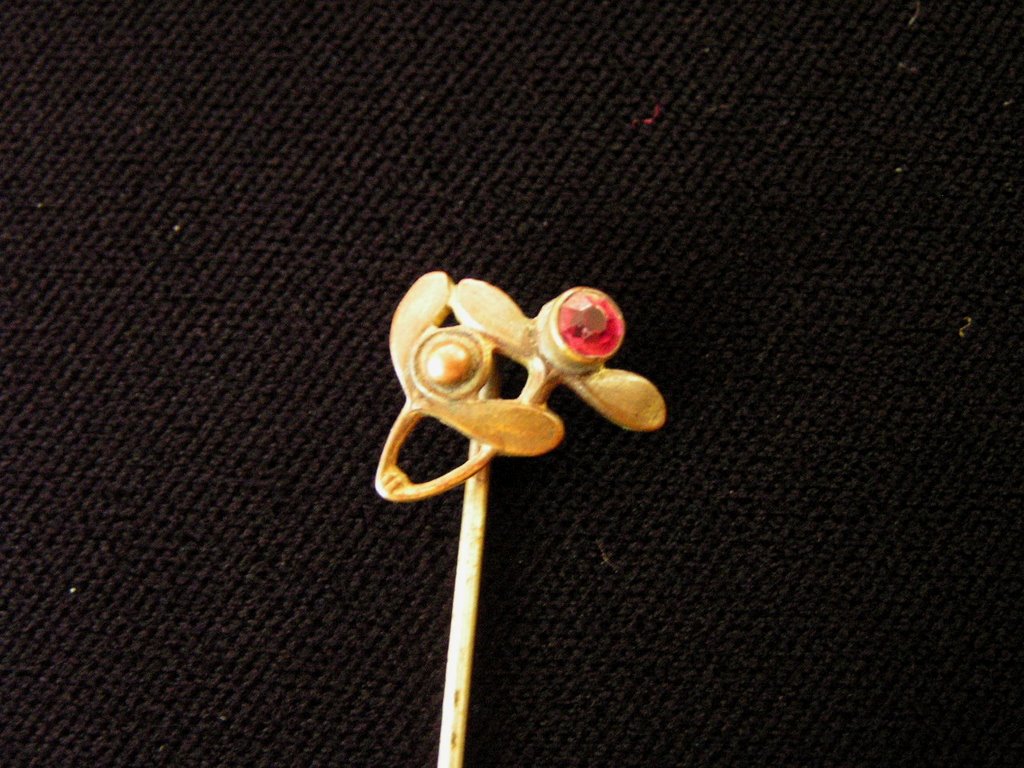
Great organic design Art Nouveau stickpin with red paste stone and nice patina. Very good condition, pin slightly bent. Price: $45

Beautiful Art Deco stickpin with a great design, green paste stone, and nice patina. Excellent condition. Price: $50

This Edwardian stickpin is too pretty not to include in this post. It is crafted from high karat gold with a nice deep hand tooling design and high quality opal. I’m keeping this one.

Monday, July 17, 2006

Victorian Social Tradition meets Craftsman Socialist Tradition

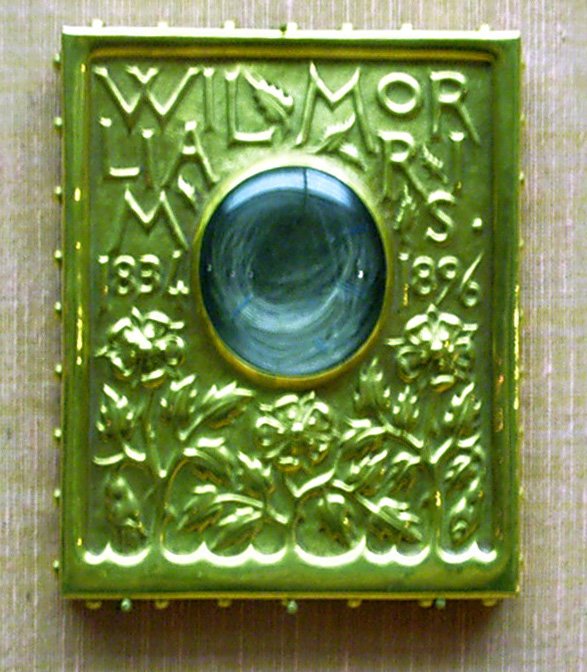
The best part of traveling to Europe is hanging out in cafes and museums and shopping for sentimental jewelry. In the Victoria and Albert Museum in London, I found this hairwork memorial for William Morris, the Arts and Crafts designer, socialist, and associate of the Pre-Raphaelite Brotherhood.

Gilt memorial plaque designed with flowers, “William Morris 1834 – 1896,” and Morris’ hair.


Morris is often remembered today for his wallpaper designs, book printing, poetry, stained glass, commitment to safe and comfortable working conditions for craftsmen (in opposition to the cramped, dangerous factories of industrial mass production) and, of course, the Morris chair, an early recliner popularized by Stickley. Gustav Stickley dedicated the first issue of “The Craftsman Magazine” 1901 to William Morris.

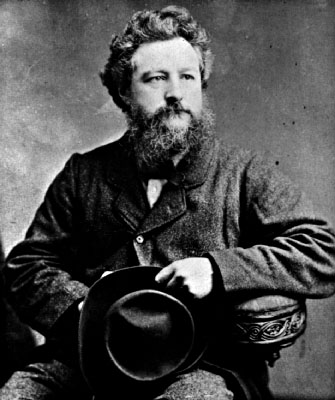
William Morris

Wallpaper design by Morris

Saturday, July 15, 2006

French Hairwork Plaque

This is one of my favorite pieces of sentimental jewelry from my personal collection. The temple of love constructed entirely from human hair contains the inscription “la tendresse nous unit” or “tenderness units us.” The dog symbolizes fidelity. Atop the altar, the five hearts metonymically represent five actual individuals, who are crowned by two birds symbolizing love and intimacy. The evergreens symbolize constancy, and the pansy, a common symbol in sentimental art, means “think of me.” These symbols unite to form an allegory emphasizing the pledge of a family and/or friends to remain tenderly devoted to each other – a pledge both embodied and reified by a class-marking artifact. Scale in centimeters.